
Tool Used
Inspiration
Ever since I got my first 3x3, I had been fascinated by its seemingly impossible mechanism that could move
pieces across both axes.
This pull towards uncovering its inner workings lead me to taking apart many cubes and learing how the pieces
interact with each other.
Additionally, I had access to a 3D printer and a makerspace nearby, so I was excited to try it.
Approach
As mentioned earlier, I mostly tried working backwards from a disassembled off the shelf cube.
I knew there would have been some explainer video or even 3D models of the pieces themselves online, but as a
challange I decided not to use any external resources.
This allowed me to come up with my own design which worked on the same principles, but had a whole lot more
problems and flaws that needed fixing.
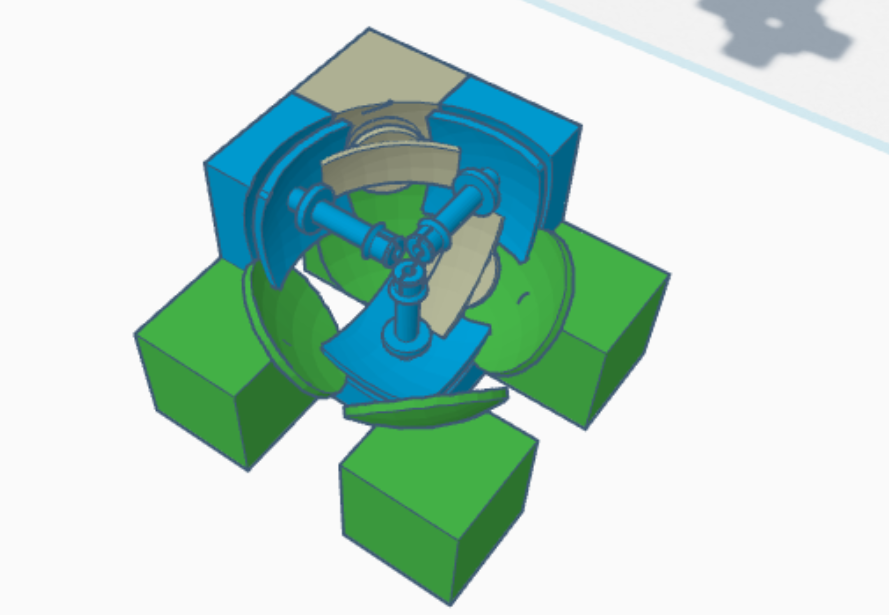
First, I drew a 2D representation of the system, which guided me to making the 3D models themselves.
Over the course of 4 months I printed many pieces, discovered and fixed problems like weak dowels, and learned
the best orientation to print a particular piece so that overhang would be limited and the layers would not be
easily separated during use.
I had to wrap up the project before I felt it was really done, as I didnt have easy access to printers towards
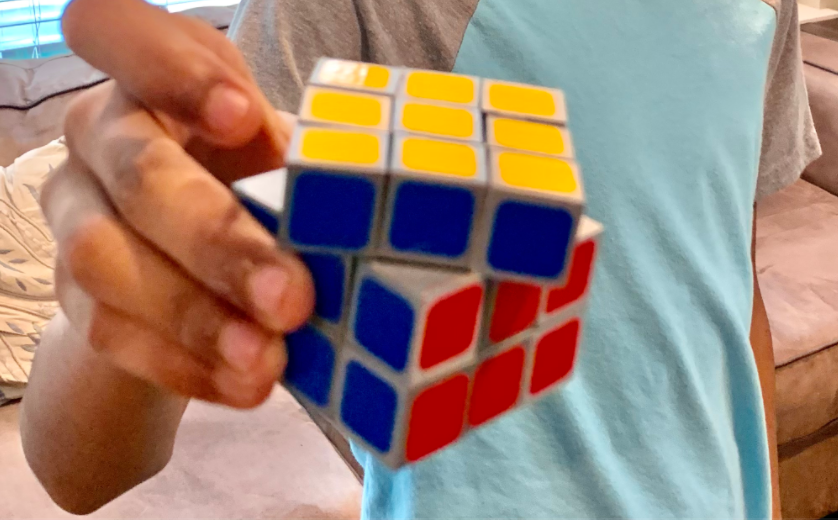
the end. Hence, it feels unfinished, but I was able to print a set of all pieces and the core to assemble the
very first prototype, which I subsequently stickered.
Next Steps
I wasn't new to Tinkercad, but I still had a difficult time especially in alignment of objects using the built
in tool, and feel like more advanced software with precise controls like AutoCAD or Fusion360 would be better
suited.
The cube is way too loose and as a result it locks up between turns. I don't believe this is an inherent flaw in
my design, but rather a collective set of problems like inconsistent prining, left on support material, and a
lack of iterations in the design which minimise gap between pieces.
The only was to fix these problems is to go through the intensive process of trial and error, which
unfortunately isn't feasible anymore without a printer close by.
Overall I am pretty satisfied at the outcome, as all I initially intended was to make a cube which could be
solved, although I would love the chance to continue working on making it better.